An Autumn Ritual from a Corfiot Kitchen
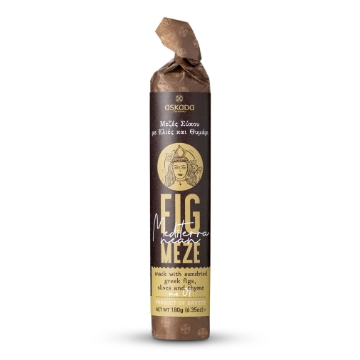
On Corfu, autumn does not begin with falling leaves so much as with the smell of figs simmering into paste. It is the moment when island households turn the last of the summer's fruit into sykomaida, the fig pie that has fed Corfiot families through the cooler months for generations. Lazaris Distillery & Artisan Sweets keeps that ritual alive from its workshop near the road to Achillion, where the confectionery side of the business shares a roof with a working still — because here, the fig pie and the ouzo that flavours it are made by the same hands, on the same island, in the same season.
The Man Behind the Recipe
The history of Lazaris Distillery & Artisan Sweets begins in 2005 with Konstantinos Lazaris, who, inspired by the kumquat fruit, has continued the island's culinary history together with his team ever since. What started as one islander's devotion to Corfu's fruit-based traditions has grown into a small but serious house of distilling and confectionery, where products remain handmade, produced in small batches, and steeped in Corfiot history and sophistication, with skilled artisans working from traditional Ionian recipes while constantly experimenting with new combinations. Visitors to the island can walk straight into this world: the production facilities are open to the public, so you can travel through the flavours and aromas of Corfu by watching the daily work, beginning in the confectionery workshop where the traditional fig pie, known locally as "sykomaida," takes shape.
What Actually Goes Into the Jar
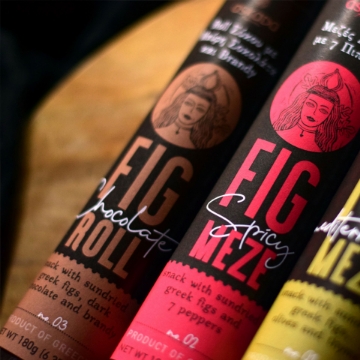
Strip away the romance and the method itself is what makes this fig pie worth seeking out. It is a paste made from dried figs, marinated in red wine, and flavoured with Lazaris ouzo, anise, fennel seeds, and black pepper. This is the more assertive of the house's fig pies — an extra-spicy result of the traditional, handmade Corfiot dish — and every one of those ingredients earns its place. The figs supply the dense, honeyed backbone; the red wine marinade deepens that sweetness into something rounder and almost winey; the ouzo threads in its warm, aniseed lift; and the black pepper gives the finish a slow, peppery bite that the milder versions of the recipe don't have.
That ouzo is not an afterthought bought in from elsewhere — it is the house's own. Lazaris ouzo is produced and bottled exclusively in Corfu, traditionally double-distilled in a bronze alembic at the distillery, with anise dominating alongside aromatic herbs and seeds such as coriander and fennel, giving it a rich aroma, robust flavour, and mellow taste. Fold a spirit like that into a fig paste and you understand immediately why this pie tastes nothing like a simple dried-fruit spread: the anise doesn't just flavour the mixture, it perfumes it.
Tasting It
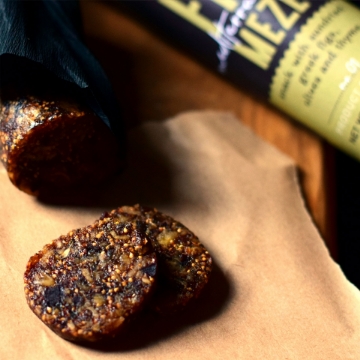
Expect a paste with real body — dark, dense, almost sculptable, the kind of texture that holds its shape on a knife rather than running off it. The first impression is fig at its most concentrated: chewy, deeply sweet, faintly winey from its time in red wine. Then the anise arrives, cool and liquorice-bright, before the black pepper closes the experience with a slow warmth that lingers at the back of the palate. It is a far more grown-up, savoury-leaning fig preserve than anything sold simply as jam — built to be eaten alongside strong flavours, not to disappear quietly into a piece of toast.
How Corfiots Actually Eat It
- With cheese and cold cuts: its peppery character pairs well with tsipouro or ouzo, and it combines deliciously with cheese and cold cuts. A firm, salty sheep's-milk cheese or a plate of cured meats is the classic partner — the fat and salt meet the fig's sweetness and the pepper's heat somewhere in the middle.
- In a green salad: it can be added as an ingredient in green salads, torn or thinly sliced through bitter leaves, where it works almost like a fig-and-spice vinaigrette in solid form.
- Alongside a good spirit: its spicy taste fits exceptionally with distillates such as tsipouro, ouzo, grappa, and brandy, making it a natural companion to an end-of-meal digestif rather than a breakfast spread.
Served this way — on a wooden board with cheese, olives, and a small glass of chilled ouzo — it becomes less a condiment and more the centrepiece of a proper Corfiot mezedes spread.
Why It's Worth Bringing Home
This is not mass-produced fig jam wearing a Greek label. It is a specific island's specific autumn dish, made in small batches by a family workshop that also distils its own ouzo a few steps away, following recipes shaped by Corfu's long, layered history at the crossroads of the Ionian Sea. Keep it in the pantry for the evening you want something more interesting than crackers and hummus, bring it out with a hard cheese and a bottle of ouzo when guests arrive, or set it beside a wedge of Kalamata olive bread as a quietly impressive addition to a cheese board. It travels well as a gift too — compact, shelf-stable, and unmistakably tied to a place, which is exactly what makes a good edible souvenir worth giving.